Let’s be real — most horror anime go for shock value.
Jump scares. Creepy sound design. Maybe a cursed videotape or two. You watch them, flinch a little, move on.
But Dark Gathering?
That show doesn’t just scare you. It mourns something.
The dark gathering anime isn’t about surviving monsters — it’s about what happens when people are already dead inside and still trying. When trauma isn’t a twist — it’s the atmosphere. When characters don’t scream because the horror outside is quieter than the one they carry around every day.
This isn’t just a ghost story. It’s a slow, bitter funeral for people who never got to grieve properly.
And yeah — that’s exactly why it hits harder than expected.
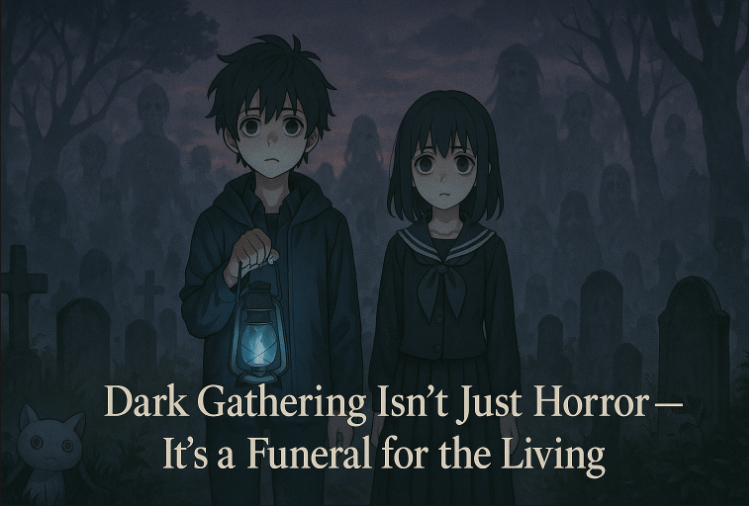
Haunted Before the Haunting: Who These Characters Really Are
Let’s talk about Keitaro.
He’s not your typical horror protagonist. No clueless bravery or comic relief. He’s soft-spoken, guilt-ridden, and visibly broken from the very beginning. You find out early on that he caused a spiritual accident that injured his childhood friend. Ever since, he’s been afraid of ghosts — and afraid of himself. He doesn’t run into horror. He’s already living in it.
Then there’s Yayoi — the real emotional gut punch.
She’s not your creepy-kid stereotype. She’s driven, calculated, and disturbingly calm around death. Her reason? Her mother was taken by a spirit. Since then, she’s basically become a kid-sized ghost hunter. But it’s not out of heroism. It’s revenge wrapped in obsession.
What makes Dark Gathering work isn’t just the ghosts — it’s that every main character is already haunted, emotionally and spiritually. The supernatural isn’t the disruption. It’s the mirror.
The scariest thing isn’t the spirits. It’s that these people would walk into death on purpose — not because they’re brave, but because they’re empty.
The Horror Hits Different When There’s No One to Save
Most horror stories give you a light at the end.
A way out.
A final girl.
A moment of peace after the storm.
But in dark gathering anime, there’s no “after.”
Even when a ghost is exorcised or contained, there’s no sense of victory. The trauma just mutates into a new form. Yayoi gets stronger, but colder. Keitaro gets braver, but more broken. Ghosts come and go, but the emotional damage just stacks.
And that’s the genius of it — there’s no reset button.
Each arc takes something from the characters. Sometimes literally. Sometimes spiritually.
It reminds me of Mieruko-chan or even Boogiepop Phantom — stories where the supernatural is more symbolic than sensational. But Dark Gathering doubles down. It asks:
“What if the scariest part of seeing spirits… is knowing you belong with them?”
That’s what makes it emotionally powerful.
Not the jump scares.
But the slow realization that these characters aren’t fighting to live.
They’re fighting to mean something before they disappear completely.
A Funeral for the Living: Loss That Doesn’t Wait for Death
What Dark Gathering nails — better than most horror anime — is the feeling of living grief.
Keitaro isn’t mourning a person. He’s mourning who he used to be. The guilt is so heavy it shapes his entire personality. Even when he’s smiling, it’s empty. He’s kind, but in that way where you can tell it’s coming from fear — not choice.
Yayoi, on the other hand, is stuck in suspended grief. Her mom isn’t “dead” in the traditional sense — she’s gone, taken, erased by something unexplainable. Yayoi’s entire life becomes about chasing the thing that hurt her. There’s no peace, no closure, just obsession disguised as purpose.
This isn’t rare in dark anime, but Dark Gathering doesn’t glamorize it. It shows how it corrodes a person.
Every ghost in the show represents a version of this:
A spirit clinging to a dead child.
A cursed object that spreads despair.
A haunted space that refuses to forget what happened there.
These aren’t just “villains.”
They’re what happens when people can’t let go, because letting go means admitting something’s over. And for a lot of people in real life, that’s harder than death.
Horror As a Reflection — Not a Distraction
There’s this idea that horror is escapism. That it lets you scream at fake monsters instead of real ones.
But dark gathering anime does the opposite. It says:
“No, let’s look directly at the real monsters — the ones that wear human faces and trauma-shaped shadows.”
And it’s not always about evil.
It’s about loss. Shame. Silence.
A lot of anime talk about friendship or redemption. Dark Gathering talks about endurance.
Not the heroic kind. The kind where you wake up, feel like nothing matters, but still show up anyway — because someone else needs you to.
That’s what makes it feel more like a funeral. Not because people die — but because the mood is heavy, quiet, and full of unspoken emotion. Like you’re not supposed to cry, but your throat is tight the entire time.
That kind of horror doesn’t fade when the screen goes black.
Final Thoughts: Not Just a Ghost Story — A Reminder of What Grief Looks Like in Motion
Dark Gathering doesn’t try to heal you.
It doesn’t even try to scare you in the traditional sense.
What it does is something more rare: it validates the emotional residue that people carry around long after the worst has happened.
The spirits are metaphors, sure. But the real horror is how accurately it captures what it’s like to be stuck — between mourning and moving forward, between fear and numbness, between being alive and feeling alive.
So if you’re looking for a horror anime that just entertains, this probably isn’t it.
But if you’re looking for a story that understands what it’s like to feel spiritually hollow and emotionally overdrawn — the kind of pain that doesn’t scream, just lingers — then dark gathering anime might be exactly what you didn’t know you needed.
It’s not here to thrill you.
It’s here to stand quietly beside you — in the shadows — and say,
“I know this hurts. I’m still here anyway.”

- Vegeta’s Pride Was Never Arrogance — It Was the Fear of Being Forgotten - October 30, 2025
- When Whitebeard Died Smiling — The Definition of a Complete Life - October 28, 2025
- Nami’s “Help Me” — The Most Human Moment in One Piece - October 25, 2025