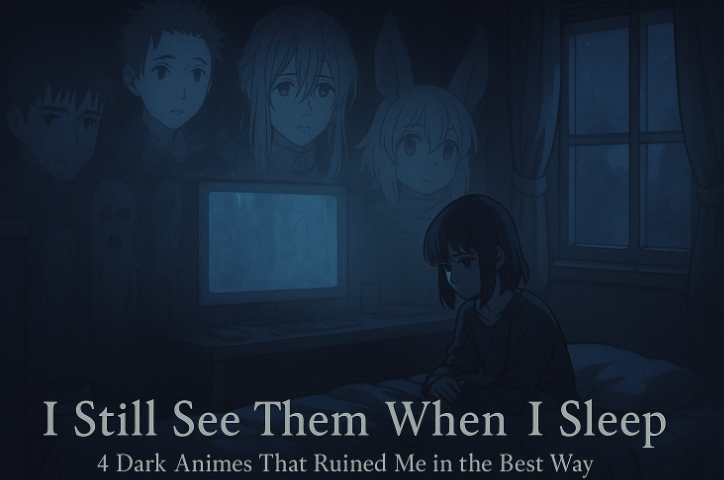
Some anime leave you entertained.
Some leave you in tears.
And some? They scar you — beautifully, permanently, like emotional tattoos you didn’t ask for but weirdly treasure.
That’s what dark anime does at its best. It doesn’t just tell you a story — it exposes you to yourself. And if you’re lucky (or unlucky), you won’t leave the same.
These four anime didn’t just “go dark.” They stuck around. They showed me things I couldn’t unsee — not because they were violent or gory, but because they knew exactly where to cut.
So here it is: four dark anime that ruined me in the best way possible — and maybe, if you let them, they’ll ruin you too.
1. Texhnolyze — Silence Hurts Louder
Let’s start with the one almost no one talks about.
Texhnolyze doesn’t care about entertaining you. It doesn’t care if you’re confused, uncomfortable, or straight-up miserable.
It wants you to feel empty — and that’s the genius of it.
The show drops you into a dying underground city where people replace limbs with mechanical parts, emotions are filtered through violence, and hope is a rumor, not a promise. The protagonist, Ichise, is a broken, brutal man — and that’s before the story really starts hurting.
What ruined me: the pacing.
Every silence feels deliberate. Every long stare feels like a scream without sound.
You start asking yourself: “Why do I need so much noise to feel alive?”
There’s no heroic arc. No redemption. Just the question:
What does it mean to keep existing when everything you knew has rotted away?
And in a weird way, that question stayed with me.
Even now, I think of Texhnolyze during the quietest, loneliest nights — when nothing’s technically wrong, but everything feels… off.
2. Now and Then, Here and There — Childhood Ends Early Here
Now and Then, Here and There starts like a throwback — cheerful kid, bright colors, a strange portal to another world.
But then you realize: this isn’t isekai. This is war.
Shu, our optimistic protagonist, is dropped into a desert dystopia where children are conscripted, villages are burned, and water is currency. But the heartbreak isn’t just in what happens — it’s in how long hope can survive in a place that doesn’t deserve it.
What ruined me: Sara.
Her story arc is one of the most brutal things I’ve seen in anime. And not because it’s violent (though it is), but because it’s real.
She’s not a fighter. She’s not “strong in a quiet way.” She’s just a girl who wanted to go home — and instead, became collateral damage in someone else’s nightmare.
Shu never gives up. And that’s where the emotional damage really lands.
Because when you’re young, you think persistence is enough. But this anime shows you the truth: sometimes, staying kind is the hardest thing you’ll ever do.
And it breaks your heart — because you want to believe he’s right.
3. Perfect Blue — Who Are You When Everyone’s Watching?
Satoshi Kon didn’t make horror. He made psychological reality checks with knives in them.
Perfect Blue follows Mima, a pop idol who quits music to become an actress — and ends up unraveling her sense of identity in the process.
But calling it “psychological horror” doesn’t really cover it. It’s not about what’s happening to her. It’s about how everyone else’s gaze becomes more real than her own sense of self.
What ruined me: the mirror scene.
There’s a moment where Mima sees a version of herself that isn’t her — smiling, waving, frozen in time. And you realize:
That’s how the world wants her to stay.
Beautiful. Innocent. Manageable.
The horror isn’t supernatural. It’s social.
It’s about how we treat women as brands, not people.
It’s about how online personas can hijack your reality.
And it’s about how losing yourself slowly is sometimes worse than death.
I watched Perfect Blue years ago, and I still check my own reflection sometimes wondering:
“Is that really me — or the version I perform for others?”
That question doesn’t leave.
4. Shiki — What If You’re the Villain and the Victim?
Shiki asks a question most horror anime don’t have the guts to touch:
“If you’re dying… and someone offers you a way out — even if it means hurting others — would you take it?”
Set in a small, isolated village where people start dying mysteriously, the story flips the usual vampire trope by making everyone morally gray. The humans aren’t saints. The monsters aren’t pure evil.
And that’s what makes it brutal.
What ruined me: the doctor.
Toshio Ozaki starts out as the town’s calm, rational voice. When he figures out what’s happening, you expect him to lead with clarity.
But instead, he snaps.
There’s a scene (if you’ve seen it, you know the one) where he performs a “test” on his wife. And by the end of it, I sat in silence, sick to my stomach — not because of what he did, but because I understood why he did it.
Shiki doesn’t want you to pick sides. It wants you to look in the mirror and admit:
“Maybe I’m capable of cruelty if I feel justified enough.”
That kind of emotional gut punch?
Yeah, it stays.
Final Thoughts: Dark Anime Doesn’t Just “Go There” — It Stays There
Here’s what I learned from these four shows:
Dark anime isn’t about gore or edge for the sake of it.
- It’s about truths that feel unsafe to say out loud.
- It’s about pain that doesn’t have a clean resolution.
- And it’s about characters who keep walking anyway.
Some of these shows I’ll never rewatch.
Not because they weren’t good — but because they were too good.
They saw the parts of me I usually keep locked away.
And they reminded me: I’m not alone in the darkness.
So if you’re looking for something comfortable, these aren’t it.
But if you want to feel something real — something that lasts —
these are the ones.
Just… don’t be surprised when they follow you into your dreams.

- Vegeta’s Pride Was Never Arrogance — It Was the Fear of Being Forgotten - October 30, 2025
- When Whitebeard Died Smiling — The Definition of a Complete Life - October 28, 2025
- Nami’s “Help Me” — The Most Human Moment in One Piece - October 25, 2025