You’ve seen the setup:
A grayscale screenshot of Shinji Ikari curled in a ball.
A still from Serial Experiments Lain, where Lain stares blankly into nothing.
A silhouette of a rooftop scene — rain, cigarette, dead eyes.
Add grain, some glitch effects, a vague caption like “I’m fine,” and suddenly it’s your phone lock screen.
Boom: “vibes.”
But let’s be honest. That dark anime wallpaper isn’t just a vibe.
It’s a mask.
A soft confession that says, “I don’t know how to talk about what’s wrong, but I’ll show you what it looks like.”
And honestly? I respect it.
Because those wallpapers aren’t random.
They’re visual bookmarks for emotions we haven’t figured out how to name yet.
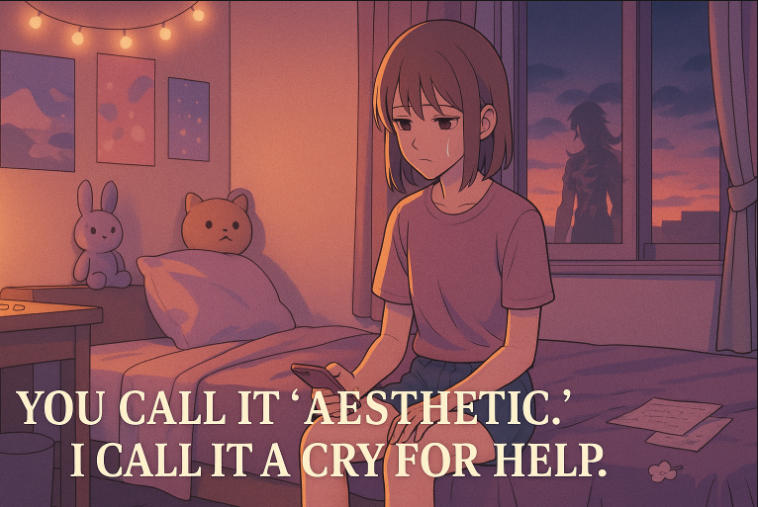
They’re quiet, static cries for help.
Why Are All My Wallpapers Sad?
Let’s talk about why so many of us gravitate toward dark anime visuals. It’s not just about the art style or the colors. It’s about the recognition.
Dark anime doesn’t cheer you up — it validates you.
It doesn’t rush in to fix you — it sits with you.
When you save that wallpaper of Guts looking out into a storm, or Violet Evergarden walking through a field alone, or Lain surrounded by static — you’re not just curating a look.
You’re curating a language.
That Guts wallpaper? It says: “I’ve seen too much and I’m still standing.”
That Lain screenshot? “I’m still here but I feel like I’ve already disappeared.”
Even the classic Kaneki mask photo? “You have no idea how much I’m hiding just to keep functioning.”
That’s the thing about dark anime wallpaper culture — it looks cool to outsiders. But if you know, you know.
Main Theme Breakdown: Pain, But Make It Beautiful
The most iconic dark anime visuals always have two layers:
- Emotional breakdown
- Aesthetic control
Take something like Neon Genesis Evangelion. The wallpapers that stick aren’t the fight scenes. It’s Shinji in the train car. Asuka underwater. Rei lying in the ruins. These moments are not loud. They’re painfully quiet. Frozen. And we turn them into phone screens, not because they look “badass,” but because they’re the only thing that feels real sometimes.
And here’s the irony — we beautify them.
We turn these raw emotional moments into polished images with clean symmetry and subtle edits. Because sometimes, it’s easier to make your pain look good than to actually explain it.
That’s what makes the aesthetic powerful — and a little dangerous.
We’re not just picking characters we like.
We’re picking versions of ourselves we don’t know how to admit to yet.
What Makes These Characters Stick: More Than Just a Moodboard
Let’s go deeper. Why do these specific characters — the “wallpaper regulars” — keep coming back?
- Kaneki (Tokyo Ghoul): Because we know what it’s like to hide pain behind a mask, and the feeling of losing yourself just to survive.
- Shinji (Evangelion): Because sometimes doing nothing feels like the only option when everything hurts.
- Lain (Serial Experiments Lain): Because online, we’re one person; in real life, we’re another; and both feel equally fake.
- Guts (Berserk): Because sometimes rage is the only way to keep going — even if it eats you alive.
These characters aren’t cool because they’re strong.
They’re cool because they’re wounded and real and still trying.
That’s what makes them ideal wallpaper material — they capture the exact moment before someone breaks.
The moment that says: “I’m holding on. But barely.”
And let’s be honest — we’ve all been there.
How This Reflects Real-Life Struggles (Without Overanalyzing)
Look, I’m not gonna hit you with “we use sad images to project our inner struggles in a socially palatable way” — even though that’s 100% true.
I’m just gonna say this:
If you’ve ever swapped your bright, motivational lock screen for something dark, slow, and sad — it wasn’t random.
It was a choice.
A quiet way of saying, “I don’t want attention. I just want truth right now.”
And that’s okay.
Dark anime wallpaper culture gives us permission to express emotion without explanation.
You don’t have to say, “I feel hopeless.”
You can just post a still of Homura staring at the burning sky, and people get it.
It’s subtle. It’s non-confrontational.
But it’s still you, reaching out in your own way.
And sometimes, that’s all we can manage.
Final Thoughts: The Wallpaper Isn’t the Problem — It’s the Warning
So no — your dark anime wallpaper isn’t “just aesthetic.”
It’s not a trend. It’s not an edgy phase.
It’s a digital diary entry you pasted on your screen because it felt safer than words.
And here’s the thing:
That’s not bad.
But it is something worth listening to.
If the image on your lock screen speaks louder than the conversations you have with your friends, that’s not a design choice — that’s a signal.
So maybe the next time someone asks, “Why do you always use such sad wallpapers?”
You don’t roll your eyes.
You just say, “Because sometimes I need to see someone else survive what I’m feeling.”
That’s what dark anime does.
It reminds you that you’re not alone — even in your worst moments.
And if that’s not worth turning into a wallpaper, I don’t know what is.

- Vegeta’s Pride Was Never Arrogance — It Was the Fear of Being Forgotten - October 30, 2025
- When Whitebeard Died Smiling — The Definition of a Complete Life - October 28, 2025
- Nami’s “Help Me” — The Most Human Moment in One Piece - October 25, 2025