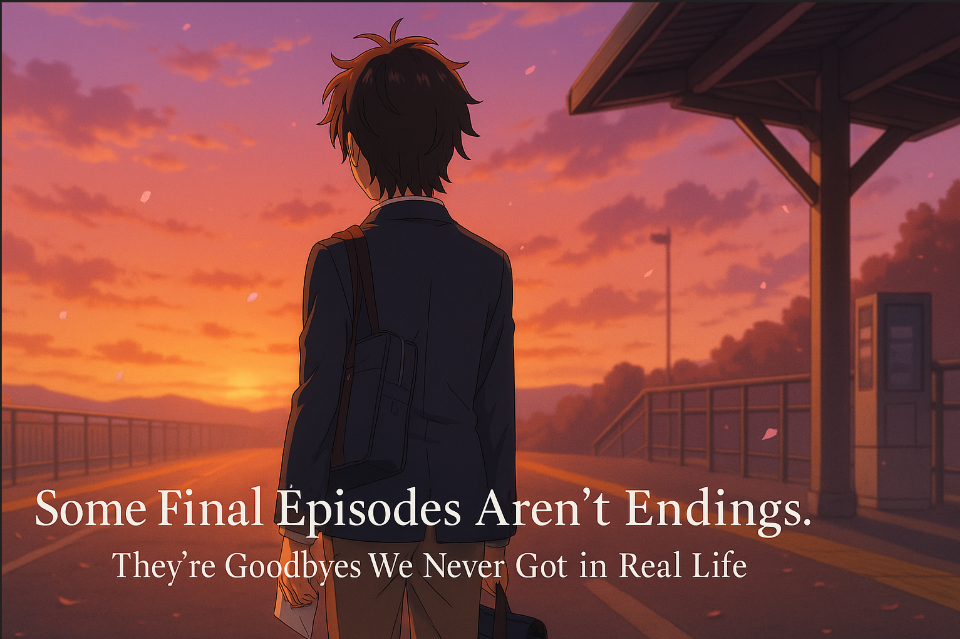
Not all endings feel like endings.
Some feel like that moment when the door closes behind someone, and you’re left with silence so loud it hums.
That’s what dark anime endings often do best — not tie things up, but leave something open inside you.
You don’t cry because it’s over.
You cry because you never got closure like that in your own life.
And now an animated character just gave it to you in thirty seconds — or worse, didn’t.
Let’s talk about the final episodes that didn’t just end stories — they echoed real, unfinished grief.
The Final Episode That Gutted Me: Texhnolyze
If you’ve seen Texhnolyze, you already know.
If you haven’t — it’s not a show I recommend lightly.
This anime doesn’t entertain. It stares at you. It asks questions no one warned you were coming. It shows you a city that’s dying, a civilization that has no answers left, and a protagonist who keeps surviving long past the point where it makes sense to.
By the final episode, Ichise has nothing. Everyone’s gone. There’s no revenge. No redemption.
Just… peace. But it’s the kind of peace that feels earned only through surrender.
When he lays down, alone in that empty world, you realize:
He’s not waiting for anyone anymore.
And that broke me.
Because most of us know what it’s like to wait for someone to come back.
To explain. To fix it. To say goodbye.
But life rarely gives you that.
And dark anime endings like this? They reflect that brutal reality back at you.
Why Dark Anime Endings Hit Differently
Let’s be real — a lot of mainstream anime endings wrap things up too clean.
The hero wins. The bad guy dies. The girl smiles. The music swells.
But dark anime endings do something else entirely.
They linger.
They ask what happens after the hero loses.
Or worse — what happens when the “hero” doesn’t matter at all.
Shows like:
- Serial Experiments Lain – where the final scene isn’t a triumph, but a disappearance. Lain becomes part of the internet. She watches, quietly, as life goes on without her. And she smiles — but it doesn’t feel like hope. It feels like letting go.
- Now and Then, Here and There – where the protagonist returns to his world, but nothing is the same. He carries war in his body now, even if no one sees it.
- Devilman Crybaby – do I even need to explain? That last shot of the world in ruins, with two bodies on a rock? It’s not just pain. It’s biblical emptiness.
These endings don’t resolve.
They haunt.
And that’s the point.
It’s Not Just About the Plot. It’s About What It Leaves Behind
Here’s what I’ve come to realize after watching dozens of these endings:
They don’t hit because they’re shocking.
They hit because they mirror the emotional loose ends we carry around.
Ever lost a friend without ever talking about why?
Ever watched a relationship dissolve without one final conversation?
Ever had someone drift away, not because they meant to, but because life quietly pushed them out of your orbit?
That’s what these endings give voice to.
We wear our unresolved grief like armor.
We don’t talk about it.
But when a show ends badly — not in quality, but in emotional clarity — it feels right. It feels familiar.
And weirdly, it feels like someone finally understood what we went through.
The Symbolism Behind “No Closure” Endings
There’s an emotional truth baked into these conclusions.
Characters like:
- Okabe Rintarou (Steins;Gate 0): who remembers everything, even in timelines that no longer exist.
- Thorfinn (Vinland Saga): who loses his entire reason for living and must rebuild without knowing what for.
- Rei Kiriyama (March Comes in Like a Lion) – not quite a “dark anime,” but its emotional quietness hits the same nerve. When he sits alone in his apartment, knowing no one will call — that’s a kind of ending too. One that repeats every night.
These characters don’t “overcome” their pasts.
They live with them.
And in doing that, they reflect what healing actually looks like — not a sunrise, but a flicker of light in a room you’ve sat in too long.
Final Thoughts: Maybe That’s Why We Keep Watching
Some people watch anime to escape.
Others watch it to feel seen.
If you’re the second type, then you probably understand this:
Dark anime endings don’t give you comfort.
They give you validation.
They remind you that maybe your story doesn’t need a clean finale to be meaningful.
That sometimes “closure” isn’t real.
And that’s okay.
Because in these broken, unresolved, quietly devastating final episodes…
we find the goodbyes we never got.
The apologies that were never said.
And the slow, uncertain acceptance that life just moves on, whether we’re ready or not.
And sometimes, that’s the real ending we needed all alo

- Vegeta’s Pride Was Never Arrogance — It Was the Fear of Being Forgotten - October 30, 2025
- When Whitebeard Died Smiling — The Definition of a Complete Life - October 28, 2025
- Nami’s “Help Me” — The Most Human Moment in One Piece - October 25, 2025