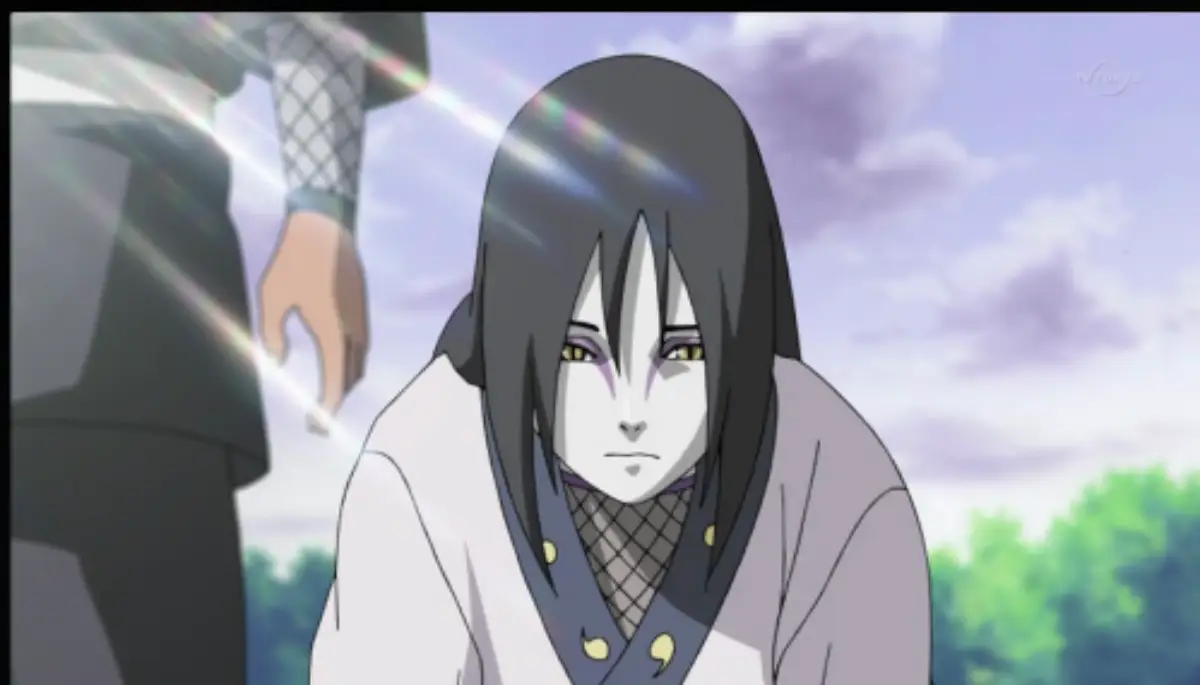
Let’s run the “what if”s through the actual scenes that shaped him, and watch how each fork in the road twisted into the snake we meme about.
The Graveyard & the Snakeskin (childhood flashback with Hiruzen)
What if Orochimaru never lost his parents so young? He’d still play with strange creatures and ask too many questions—but he wouldn’t be staring at a shed snakeskin, whispering about rebirth like it’s a lifeline.
What happens instead: After yet another funeral, he fixates on snakes molting. Shedding becomes a metaphor: if the old self keeps getting hurt, make a new one. The moment looks small, but it’s the seed. Immortality, for him, isn’t “I want to live forever.” It’s “I can’t keep losing everyone.”
Why this matters: A normal curiosity turns into a plan for never saying goodbye again.
The Hospital Corridor (Tsunade can’t save Dan)
What if his teammate lived? Maybe Orochimaru stays a morbid prodigy with harsh opinions, not a man who concludes that medicine can’t outpace death.
What happens instead: He watches Tsunade’s hands shake, blood on the floor, and he registers a brutal law: love loses to time. Jiraiya clings to people. Tsunade clings to healing. Orochimaru looks at the same loss and decides, “I will never be powerless again.”
Why this matters: Three Sannin, three answers to trauma—and his is the one that stops caring whether the rules break.
The ANBU Lab Raid (experiments exposed)
What if someone caught him earlier and pulled him back with actual accountability + help? He might still be cold, but he’d have boundaries.
What happens instead: The hidden doors swing open: jars, seals, human subjects. He’s already crossed the line from “study death” to “dismantle people.” He calls it progress. It’s Shou Tucker energy from Fullmetal Alchemist, but stewed in years of shinobi funerals and weaponized brilliance.
Why this matters: His noble fear of mortality mutates into a methodology: if people vanish, make people into parts.
The Rooftop with Hiruzen (defection choice)
What if Hiruzen’s pleading landed? Maybe a lifetime of penance, not a lifetime of body-hopping.
What happens instead: Orochimaru hears “forgive and forget” from a world that keeps burying kids. He walks. The village that makes child soldiers tells the one genius who won’t “move on” to just… move on. He refuses. If the machine grinds you, become the blade.
Why this matters: The break isn’t sudden; it’s philosophical. He won’t be meat in the grinder—so he becomes the grinder.
Chūnin Exams / Konoha Crush (snake emergence)
What if this were a Saturday-morning villain intro? We’d just boo the creepy snake sorcerer.
What happens instead: Under the horror, the logic shows: invade, test, replace the failing body, keep moving. The problem isn’t that he wants power; it’s that power is the only thing that ever stayed. This is the grief spiral wearing a lab coat.
Why this matters: The terror isn’t the syringes; it’s the reasoning. “If I can’t stop loss, at least loss can’t stop me.”
The Sannin Standoff / Jiraiya’s Hand (the almost-return)
What if Jiraiya’s offer to come back had come with real repair, not just nostalgia? We might have gotten a bitter, living cautionary tale inside the village.
What happens instead: Orochimaru shrugs off the lifeline. He’s too far down the path where people = resources. Bonds mean grief; grief means rot; rot means replace the body and keep moving. You can hear the door lock.
Why this matters: He’s not allergic to love—he’s allergic to losing it again.
War-Era Orochimaru (the unsettling pivot)
What if he’d stayed cackling in caves forever? Simpler story. Easier to hate.
What happens instead: He slithers back into the plot like a haunted scientist: revives the Hokage, nudges Sasuke toward answers, prevents spirals. The crimes don’t vanish; the ledger is still red. But the mask slips just enough to show a tired mind looking for data, not carnage.
Why this matters: He isn’t redeemed; he’s complicated. The scared kid is still under there, now too numb to be either hero or demon in a clean way.
The Quiet Tears (yes, they exist)
What if he never showed a crack? We’d keep the meme: “creepy snake freak.”
What happens instead: A few rare frames—shaken by a comrade’s death, eyes wet around Tsunade’s failure—reframe the whole arc. This wasn’t boredom. It started as panic with a brain.
Why this matters: Once you see those tears, the snakes read less like style and more like a prayer for a body that can’t be abandoned.
So… What if Orochimaru hadn’t snapped at each fork?
- No early funerals: curiosity stays curiosity; rebirth is a metaphor, not a mission.
- Dan lives / fewer losses: Tsunade heals, Jiraiya mentors, Orochimaru researches grim topics without making people into parts.
- Caught + treated, not just scolded: we get a brittle Konoha scientist with ethics cuffs, not a body thief.
- Real reintegration: the Sannin become three broken adults who stay, each guarding a corner of the village’s soul.
But that’s not the world they live in. The shinobi system manufactures absence—teammates, parents, students. Orochimaru refuses to be another absence, so he chases a version of presence that devours everyone else’s.
What actually makes this dark (and why it sneaks up on you)
- Fear of death → fear of being forgotten. Immortality is memory insurance.
- Loss → isolation. Friends become raw material, because friends leave.
- Genius → justification. “For science,” “for peace,” “for the village”—the slope is greased with good reasons.
- Rebirth motif → self as experiment. If the skin hurts, shed it. If the body breaks, replace it. Repeat until no one can hurt you, and no one can reach you.
It’s Tokyo Ghoul’s “survival makes monsters,” but swapped with ideas as the predator. It’s Attack on Titan’s war trauma scaled down to one mind. It’s Demon Slayer’s sympathy for demons—except this demon built himself on purpose.
Final “What if” — What if we stop pretending he’s just the snake gag?
Then Orochimaru reads like a casualty of the same world that crowns heroes from children. Not forgivable—never—but legible. The village asks everyone to move on. He refuses, and becomes the nightmare solution: if loss is inevitable, outlive it.
Once you see that, every shed skin looks less like a flex and more like a plea:
“Don’t leave me behind again.”

- Vegeta’s Pride Was Never Arrogance — It Was the Fear of Being Forgotten - October 30, 2025
- When Whitebeard Died Smiling — The Definition of a Complete Life - October 28, 2025
- Nami’s “Help Me” — The Most Human Moment in One Piece - October 25, 2025