Quick questions: Why does Gaara carve “love” into his forehead? What happened to make him stop sleeping? When did he break? Keep those in your head while we walk through the exact scenes that turned a sweet kid into a weapon.
Scene 1 — The Assassins: “Your Father Wants You Gone”
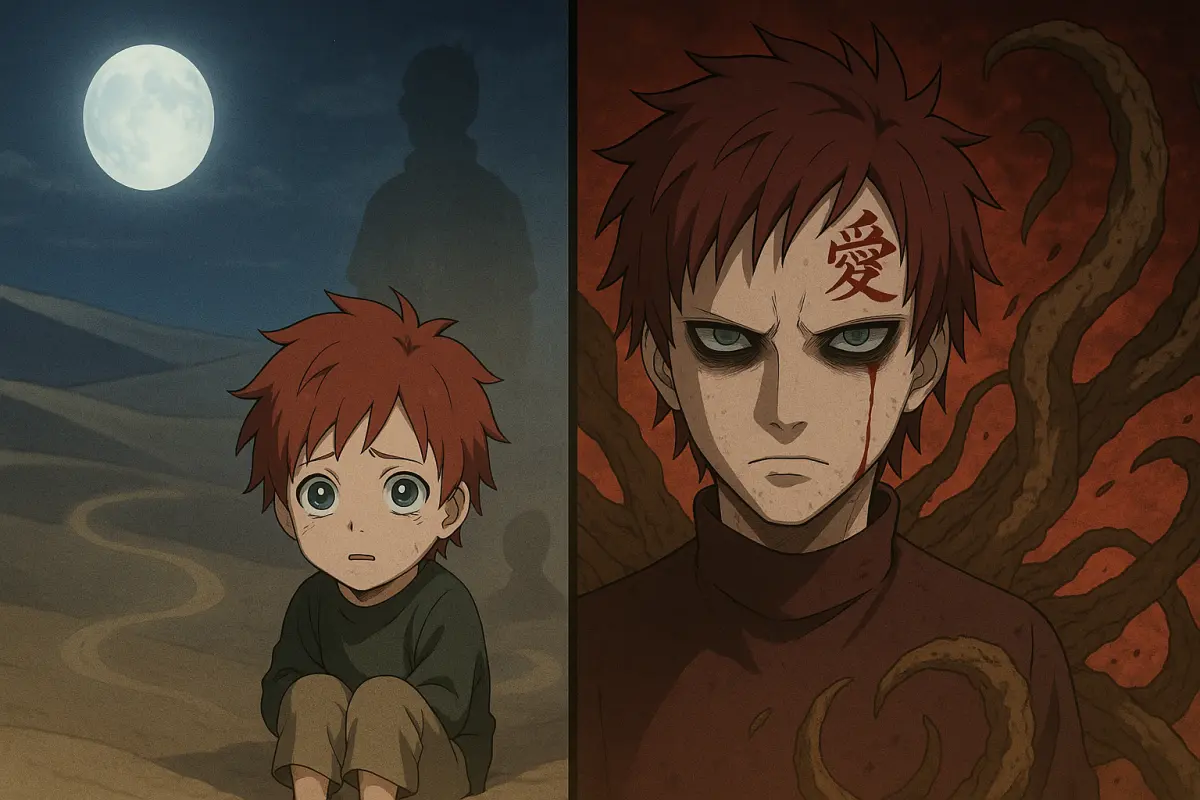
Six years old. Sand swirling. ANBU masks in the moonlight. And the orders? From the Kazekage—his own father. The kid fights for his life with the only friend he has: the sand that protects him on instinct.
- What you learn here: Gaara’s baseline isn’t “edgy.” It’s survival mode against the person meant to protect him.
- Quick question #4: What kind of village calls that “protection”?
Scene 2 — Yashamaru’s Answer: “Your Mother Hated You”
Gaara goes to the one adult who felt safe: Yashamaru. He asks if his mother loved him. The answer is a knife“no”and then the bomb collar snaps. Yashamaru blows himself up on command and tries to take Gaara with him.
- What you learn here: the betrayal isn’t just physical; it rewrites Gaara’s origin story. Love = lie. Family = trap.
- Fallout: this is the crack that never closes. If even this was fake, what isn’t?
Scene 3 — The Insomnia: “Don’t Sleep or the Monster Comes Out
Inside Gaara is Shukaku, the One-Tail. Sleep lets Shukaku surface, so Gaara simply…doesn’t. Night after night, the sand is his blanket and his prison.
- What you learn here: he isn’t “unstable”; he’s a child running on fumes, paranoid and alone.
- Quick question #5: What happens to a kid who never rests, never feels safe, and never hears “you matter”?
Scene 4 — The Only “Friend” Was a Setup
He finally connects with someone. Smiles. Reaches out. Then finds out it was all staged—another test, another knife disguised as kindness.
- What you learn here: this is the flip switch. Trust goes to zero. Pain becomes policy.
- Result: Gaara stops asking for love and starts guaranteeing survival.
Scene 5 — The Decision: “Love” Carved in Bloo
Alone on the sand dunes, he etches 愛 (love) into his forehead—“a demon who loves only himself.” It’s not a cool tattoo. It’s a mission statement: if the world rejects me, I’ll be my own reason to live.
- What you learn here: rage isn’t his origin; loneliness is. The violence you see later? It’s pain, externalized.
Scene 6 — The Mirror Match: Naruto vs. Gaara
Forest battlefield. Two kids with monsters inside them. One had bonds to pull him back; one had bombs to push him away. Naruto says, “I know that pain,” and means it.
- What you learn here: Gaara isn’t “evil for evil’s sake.” He’s what Naruto could have been without a hand to grab.
- Quick question #6: What changes when someone finally says, “You’re not alone”? Everything—Gaara’s arc bends toward the Kage he becomes.
Why Gaara’s Backstory Hits Harder Than Most
- It’s not a single tragedy; it’s stacked harm—parental betrayal, weaponization by the village, engineered isolation, and a literal demon that punishes sleep.
- The sand coffins and crushing aren’t “cool powers”; they’re pain made visible.
- His redemption works because it’s not about beating him—it’s about reframing his worth.
Final Thought
Answer those quick questions now:
- Why the carving? To manufacture self-love after every other door slammed.
- Why no sleep? Because safety never existed.
- When did he break? When the last “safe person” tried to kill him.
That’s why Gaara’s childhood still feels like one of the darkest things in Naruto. It isn’t just shock value—it’s a blueprint for how a kind child turns into a monster…and how one honest “I get it” starts turning him back.

- Vegeta’s Pride Was Never Arrogance — It Was the Fear of Being Forgotten - October 30, 2025
- When Whitebeard Died Smiling — The Definition of a Complete Life - October 28, 2025
- Nami’s “Help Me” — The Most Human Moment in One Piece - October 25, 2025