Some anime don’t just entertain — they gut you.
They don’t hand you hope on a silver platter or wrap up pain with easy redemption. Instead, they sit with the hurt, let it fester, and dare you to do the same.
That’s why dark anime has always pulled me in. Not because I’m edgy or obsessed with suffering, but because these stories don’t lie. They don’t pretend that every wound has a bandage or that every lost thing comes back.
They show the version of ourselves we try to bury — and that hurts more than any plot twist.
The Quiet Violence of “A Silent Voice”
At first glance, A Silent Voice looks like a redemption arc — boy bullies girl, regrets it, seeks forgiveness. But it’s not that clean. Shoya isn’t trying to be forgiven — he’s trying to disappear without making a sound. That’s the part that hit me.
What stuck wasn’t the apology. It was the self-loathing that didn’t magically go away after a few good deeds. There’s a scene where Shoya walks through school with everyone’s faces literally X’d out — an insanely accurate metaphor for social anxiety or depression that feels too real to be stylized.
Nishimiya doesn’t get a feel-good ending either. Her pain is brushed off by the people around her, and she internalizes it like it’s her fault. That’s the kind of emotional weight dark anime isn’t afraid to explore — not trauma as backstory, but trauma as a current operating system.
“Violet Evergarden” and the Grief You Don’t Know How to Name
I didn’t expect Violet Evergarden to wreck me. It’s beautiful, polished, and slow — not the kind of anime that punches you. But that’s what made it dangerous.
Violet is a soldier turned ghostwriter, trying to understand emotions after living as a literal weapon. When she asks, “What does ‘I love you’ mean?”, it’s not cute. It’s terrifying. Because it’s not just about love — it’s about the void where connection should’ve been. She doesn’t have the vocabulary for her own feelings.
There’s an episode with a sick mother writing letters for her daughter to receive after her death. No twists. No subversion. Just slow, cruel reality. That episode left me staring at the ceiling for an hour. Not crying — just empty.
That’s the genius of shows like this. They don’t dramatize grief. They respect it. They let you sit in the silence after loss instead of rushing to move on.
The Darkness Isn’t the Point — It’s the Mirror
Let’s be real: a lot of people think dark anime is just “sad stuff” or “edgy trauma bait.” But the best of them aren’t about pain — they’re about recognition.
Take Monster, for example. Dr. Tenma saves a boy who becomes a literal sociopath. The rest of the story spirals into a question that haunted me for weeks: “Does doing the right thing still matter if it leads to something terrible?” It doesn’t give you a clear answer. That’s the point.
Or Texhnolyze, which almost no one talks about. That show is brutally slow, depressing, and borderline unwatchable at times — but if you stick with it, it becomes a meditation on meaninglessness and what people cling to when society collapses.
It’s not about being miserable. It’s about asking:
“What do I do when everything that used to make sense doesn’t anymore?”
“What part of myself survives when the rest is gone?”
That’s what makes dark anime feel like a mirror. And yeah, mirrors don’t always flatter you.
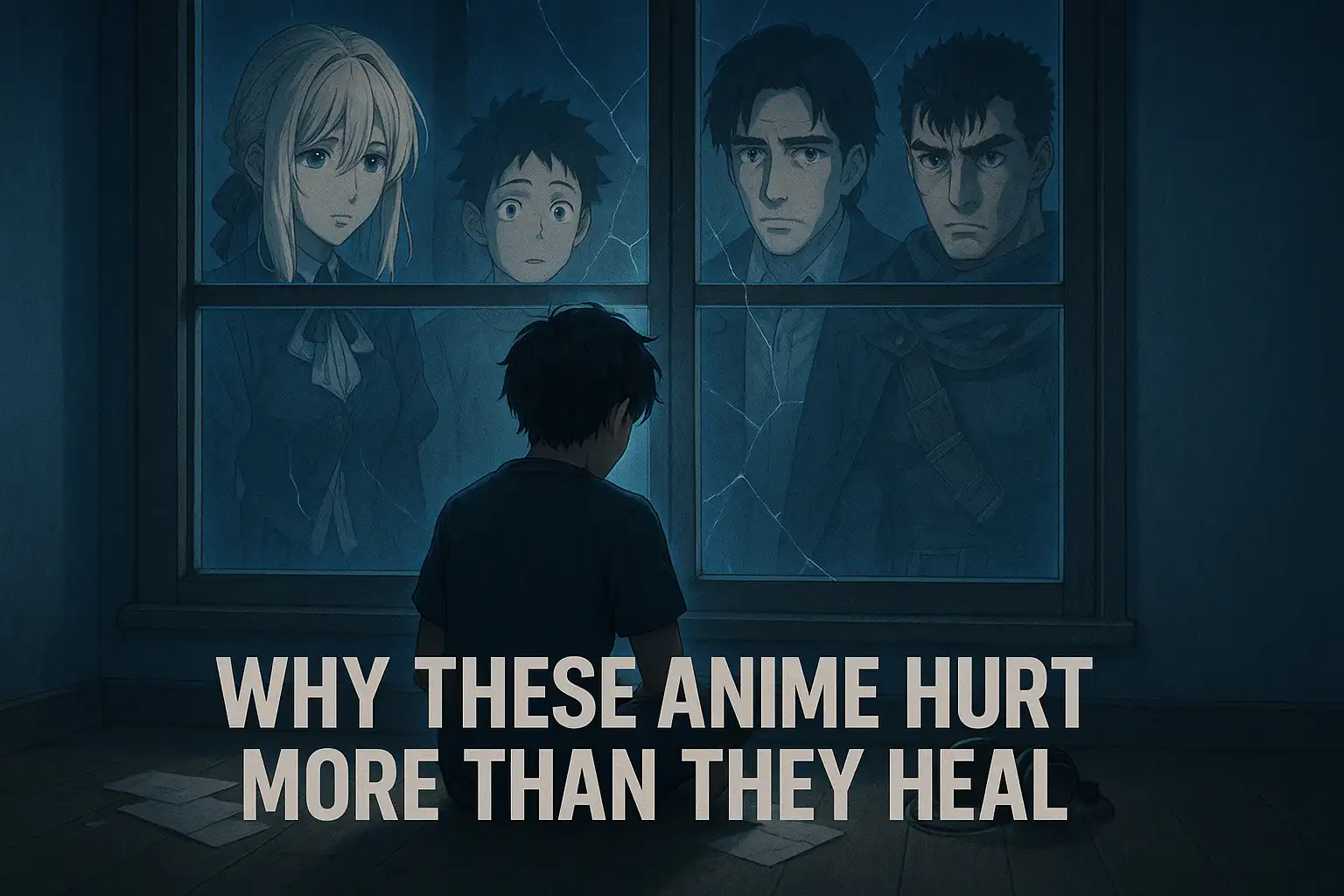
Why These Anime Hurt More Than They Heal
The truth? Some people watch these shows and feel understood. Others feel worse. And both are valid.
Because dark anime doesn’t hold your hand. It doesn’t offer “life lessons” in a digestible format. It doesn’t pretend every trauma is something you can grow from. Sometimes the characters don’t get better. Sometimes they don’t want to.
In Berserk, Guts survives things no one should, but survival doesn’t mean healing. His rage keeps him going — not hope. That’s a hard pill to swallow in a world that loves redemption arcs.
Even Paranoia Agent dives into how people create delusions to escape pain, and how those delusions can turn into monsters. Watching that made me realize:
Sometimes the thing that saves you is also the thing that’s destroying you.
That’s why these anime don’t “heal.” They don’t want to.
They want to sit in the truth, even if it sucks.
How It Hits in Real Life (Whether You’re Ready or Not)
There’s no way to sugarcoat this: I’ve watched anime at my lowest points. Not for escape, but because I wanted someone — even if fictional — to tell me my pain wasn’t unique. That it wasn’t stupid. That it didn’t need to be “fixed” right away.
When Violet quietly breaks down after realizing the Major is never coming back…
When Shoya thinks the world would be better without him…
When Guts screams at a sky that never answers…
—I see pieces of myself I don’t show anyone.
And it’s not “cathartic.” It’s uncomfortable. But sometimes you need that. Not advice. Not comfort. Just a space where pain exists and is seen.
If you’ve ever felt broken in a way that doesn’t show up in a diagnosis… these stories feel less like fiction and more like reflection.
Final Thoughts: Not Everything Needs to Heal You
There’s a weird expectation in media right now that everything should be “healing,” “wholesome,” “inspirational.”
But life isn’t always that. And neither is good art.
Dark anime doesn’t give you answers — it gives you space.
A space to feel grief without a deadline.
A space to see characters who don’t get better, but keep going anyway.
A space where your wounds aren’t fixed — just acknowledged.
So no, these anime didn’t heal me.
But they made me feel seen. And sometimes, that’s the first step to anything better.

- Vegeta’s Pride Was Never Arrogance — It Was the Fear of Being Forgotten - October 30, 2025
- When Whitebeard Died Smiling — The Definition of a Complete Life - October 28, 2025
- Nami’s “Help Me” — The Most Human Moment in One Piece - October 25, 2025