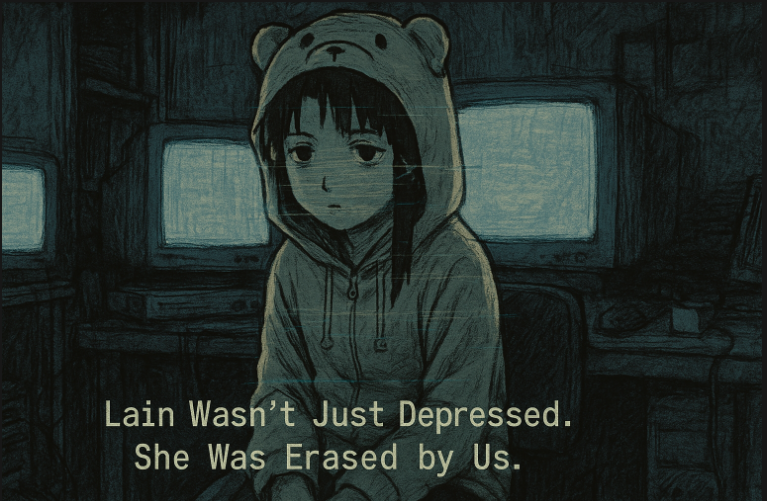
You don’t “watch” Serial Experiments Lain. You fall into it.
You sit through the static, the low hum of CRT monitors, the disconnected voices, and at some point you realize — this isn’t about the internet. It’s about disappearance.
Not vanishing in a cool sci-fi way.
Not even death.
Just… the kind of disappearance that happens when no one is really looking at you.
When people know your face but not your voice.
When your online presence feels more real than your actual life — and eventually, you stop knowing the difference.
That’s what makes Lain more than just another darkness anime.
It’s not about digital horror or cyberpunk confusion.
It’s about how we all participated in Lain’s erasure — not as villains, but as bystanders.
Lain Isn’t Confused — She’s Being Rewritten
Let’s start with this: Lain Iwakura isn’t clueless. She’s not some wide-eyed girl who stumbles into a glitchy online conspiracy.
She knows something’s wrong.
She feels it before she understands it.
Her family talks to her like she’s barely there. Her friends act like she’s different versions of herself depending on where they see her — in school, online, or the Wired.
One of the most striking things about her character is how passive she seems — not out of weakness, but out of disorientation. She’s being re-coded in real time. Even her body glitches. The Lain in the Wired starts acting independently. People attribute things to her she never said or did.
And nobody asks her what she thinks.
Because the moment the digital version of her becomes more interesting, more useful, more “alive” —
the real Lain becomes irrelevant.
The Emotional Power Isn’t in the Plot — It’s in the Quiet
There’s no traditional horror in Serial Experiments Lain.
No jump scares. No gore. Just a low, consistent dread — like a dial-up tone stuck in your brain.
This is what makes it one of the most emotionally unsettling darkness anime out there.
Lain’s journey isn’t framed as a battle.
It’s framed as a slow, internal unraveling — the kind you don’t notice until it’s already too late.
She loses herself in layers:
First, her identity starts splintering.
Then, her relationships fracture.
Eventually, her existence becomes negotiable.
And yet the world keeps turning.
People talk about Neon Genesis Evangelion being emotionally heavy (which it is), but Lain hits differently. Because it’s not about loud trauma — it’s about the trauma of being ignored while you’re still alive.
The pain is in the quiet — the hallway scenes with no dialogue. The blank stares from her father. The static slowly leaking into everyday life. And Lain just… trying to stay grounded.
The Scariest Part? It’s Familiar.
Let’s drop the cyber stuff for a second.
What happens to Lain isn’t fiction. It’s just metaphor pushed to the limit.
Think about it:
How many versions of “you” exist online right now?
Your IG profile. Your Discord persona. Your private alt where you say the things you really mean.
And sometimes — admit it — the “you” online feels more present than the one who went to work today, sat through class, or answered your mom’s call with a fake smile.
That’s not science fiction.
That’s normal now.
Lain wasn’t “just depressed.” She was mirroring the fractured identities we all perform daily — before most of us knew that was even a thing. She felt the glitch in the system and tried to hold on to a single self, but everyone around her — us, the viewers, the society in the show — kept telling her:
“You don’t really exist unless you’re interesting online.”
And so Lain does what anyone would do in that situation:
She fades out of her real life.
And leans into the version of herself people actually respond to.
Until there’s nothing left.
Lain Wasn’t the Monster. We Were.
There’s a moment near the end of Serial Experiments Lain where she has the chance to delete herself entirely — not out of some grand sacrifice, but because she realizes the version of her people want is better than the real thing.
It’s the quietest apocalypse you’ll ever watch.
And it hits harder because no one notices it happening.
What makes this such a standout darkness anime isn’t just the atmosphere or the narrative weirdness.
It’s that it never lies to you.
It tells you:
- Loneliness can exist even when you’re connected to thousands of people.
- Being perceived is not the same as being known.
- Digital presence doesn’t save you — it replaces you.
And the scariest part?
Everyone’s fine with that.
Even us.
We like the Wired-Lain. She’s confident. She’s powerful. She matters.
But the real Lain — the quiet, scared, glitching girl who just wanted to go to school and feel real?
We forgot about her the moment the screen started flickering.
Final Thoughts: We Didn’t Lose Her — We Let Her Go
So no, Lain wasn’t just depressed.
She was erased.
By design.
By the world around her.
By us.
She’s not just another misunderstood character in a dark anime. She’s a warning that showed up early — a character who lived through what many of us now call “normal internet life,” long before it became our reality.
Her story still echoes today because we’ve all felt it:
That sense of being hyper-visible and invisible at the same time.
That creeping fear that your online self might be the only version people care about.
That deep, quiet panic that maybe even you don’t know who you are anymore.
Lain didn’t die.
She just gave people what they wanted — and disappeared.
We didn’t destroy her.
We just stopped looking.
And maybe that’s what makes Serial Experiments Lain not just a classic, but a timeless darkness anime — because it doesn’t just make you feel sad.
It makes you feel seen.
And then it dares to ask:
If people only see the version of you they want… do you still exist?

- Vegeta’s Pride Was Never Arrogance — It Was the Fear of Being Forgotten - October 30, 2025
- When Whitebeard Died Smiling — The Definition of a Complete Life - October 28, 2025
- Nami’s “Help Me” — The Most Human Moment in One Piece - October 25, 2025