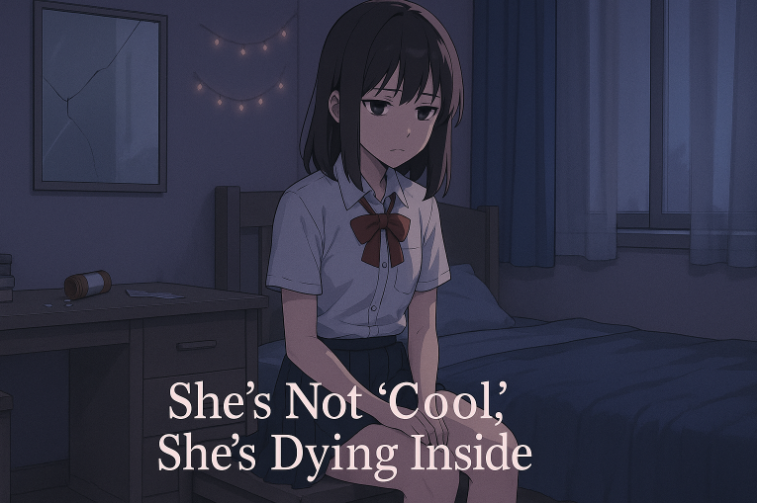
You know that girl.
The one with deadpan eyes, perfect grades, and a voice that barely rises above a whisper. She moves through chaos like she’s already seen the worst of it. Unbothered. Untouchable.
People call her cool. Mysterious. Sometimes even “waifu material.”
But let’s be honest:
That “dark anime girl” isn’t cool.
She’s exhausted.
She’s numb, not collected.
She’s not mysterious — she’s just not letting anyone in because last time she did, she shattered.
And that hits different when you’ve ever been that person in real life.
The Archetype: A Shell with a Backstory You Probably Missed
Let’s get this out of the way: the “dark anime girl” isn’t just a trope. She’s a whole emotional blueprint — from Rei Ayanami to Tomie to Makima. But we rarely talk about what’s actually going on behind that quiet facade.
Take Rei Ayanami from Evangelion.
She’s usually reduced to “emotionless girl clone.” But if you look closer, Rei doesn’t lack emotions — she just doesn’t know what to do with them. Her identity isn’t even her own. Her body, her life, her choices — all orchestrated by someone else.
Every time she starts to find some semblance of self, it’s ripped away. She’s not cold. She’s just never been allowed to exist for herself.
Or Homura Akemi from Madoka Magica.
She starts off as shy and awkward. But loop after loop, she hardens — until she becomes the embodiment of control. But that “coolness”? It’s desperation in disguise. She’s trying to protect one person by destroying everything else, including herself. She’s literally time-traveling through endless trauma and we’re still out here calling her “badass” without realizing she’s barely holding it together.
The dark anime girl doesn’t show pain the way we expect — and that’s exactly why people misread her.
What Makes Her Powerful (And Terrifying): Stillness in Chaos
You ever notice how the darkest characters rarely scream?
They don’t flail or panic. They endure. And in a world that values performance, silence is unsettling.
Characters like Yor Forger from Spy x Family balance everyday charm with terrifying efficiency. She’s a literal assassin hiding behind polite smiles. It’s entertaining, sure. But when she questions her worth outside of violence — when she wonders if she can be a good mother or wife — those moments hit harder than any kill scene.
Or Satsuki Kiryuuin in Kill la Kill. She stands tall, speaks like a war general, and never flinches. But her whole persona is a constructed shield — a way to protect herself and others from a system that nearly devoured her. Her control isn’t confidence. It’s armor.
What makes these girls powerful isn’t magic or violence. It’s that they’ve suffered — sometimes endlessly — and still function.
Still stand.
Still carry everyone else’s weight when no one notices they’re breaking.
Why It Resonates: It’s Not About Trauma — It’s About Containment
Here’s where it gets real.
The dark anime girl doesn’t feel relatable because she’s tragic.
She feels relatable because she’s contained.
She doesn’t get the luxury of breakdowns.
She gets things done, quietly. She doesn’t cry at the right times. She overreacts at the wrong ones. She’s misunderstood because her pain isn’t loud enough to count.
For anyone who’s ever felt emotionally flat because life drained the highs and lows out of you — she’s you.
For anyone who’s ever smiled because it was expected while dying inside — she’s you.
For anyone who’s been praised for “handling things well” while unraveling in secret — yeah. She’s you too.
That’s why fans either fetishize her or misunderstand her:
Because stillness in women gets misread as “cold” or “stoic” when it’s actually just survival mode.
The Irony of Aestheticizing Her Pain
It’s easy to turn the dark anime girl into an aesthetic.
Black uniforms. Red eyes. Monotone voice. Rainy window shots.
But when we reduce her to “vibes,” we ignore what created her.
These aren’t just sad girls. They’re coping mechanisms with legs. They represent what happens when someone learns early that their feelings are too much for the world — so they shut it all down.
It’s not edgy. It’s not poetic.
It’s survival.
Take Mima Kirigoe from Perfect Blue. Her descent into identity crisis and psychological breakdown is one of the most raw portrayals of fractured self-image in anime. People still post screenshots of her blank stare like it’s an aesthetic — forgetting that she’s literally having a mental breakdown because her body and image have been commodified beyond recognition.
That’s the problem: we love her look, but not her story.
We want the “cool girl” but not the truth underneath her silence.
Final Thoughts: Maybe She’s Not Broken. Maybe She’s Just Tired of Performing.
The dark anime girl isn’t here to be fixed. She’s not your goth dream girl. She’s not your mystery to solve. She’s not your redemption arc waiting to happen.
She’s just… exhausted.
And maybe that’s the most human thing about her.
She keeps going anyway.
If you’ve ever felt like you had to numb out just to get through the day, or like being “low maintenance” was the only way to be loved — then you already understand her more than you think.
So next time you see her in a series — staring out a window, speaking in half-sentences, walking away from someone who finally noticed her pain — don’t call her cool.
Call her what she really is:
A survivor.
Let’s stop mistaking numbness for mystery.
Because behind every “cool” dark anime girl is someone who stopped showing pain — not someone who stopped feeling it.
And maybe the bravest thing she ever did wasn’t fighting monsters —
but carrying her own heartbreak in silence for years without anyone noticing.

- Vegeta’s Pride Was Never Arrogance — It Was the Fear of Being Forgotten - October 30, 2025
- When Whitebeard Died Smiling — The Definition of a Complete Life - October 28, 2025
- Nami’s “Help Me” — The Most Human Moment in One Piece - October 25, 2025