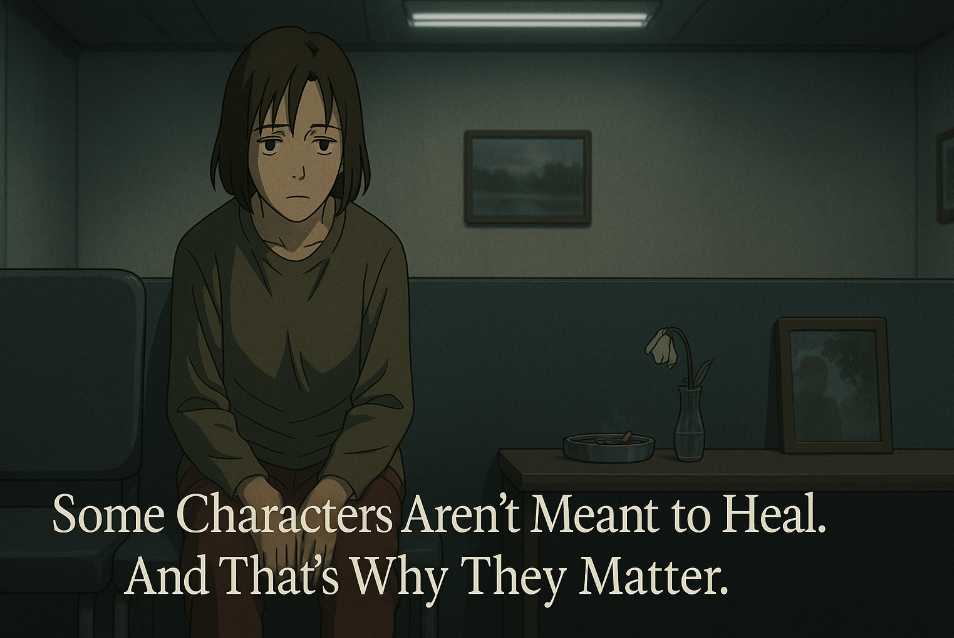
Not everyone gets a redemption arc.
Not every story ends with recovery, closure, or healing.
And honestly? That’s okay.
Because sometimes, the characters who don’t heal are the ones that stick with you the longest.
We all love growth. We all want our faves to rise above their trauma, to break the cycle, to “choose peace.” But in dark anime, not everyone gets that chance. Some characters spiral. Some break. Some just… stop trying.
And it’s not pointless. It’s not “edgy.” It’s real.
Tragic character arcs aren’t just there to hurt us. They’re there to show us something we don’t often talk about:
That pain isn’t always something you “get over.” Sometimes it just becomes part of you.
And in a way, that honesty matters more than any happy ending.
The Characters Who Don’t Come Back — And Why That Matters
Let’s talk about Rei Ayanami for a second.
She’s quiet, robotic, emotionally distant — until you realize she’s not even supposed to be a full person. She’s a manufactured soul, a tool in a much larger plan. But even with that knowledge, she starts developing her own sense of identity. And just when you think she might become something more… the world swallows her whole.
There’s no emotional breakthrough. No moment of clarity.
Just fragments — of thought, of self, of barely-there connection.
And somehow, that hits harder than any redemption arc.
Because it reflects something uncomfortable:
Not everyone gets to become who they want to be.
Not everyone gets time.
And Rei’s tragic stillness — her slow unraveling — shows how a character can be emotionally powerful because she never heals.
What Makes Tragic Character Arcs Emotionally Powerful
So, what makes these broken characters work so well?
Here’s the thing: dark anime doesn’t flinch from emotional permanence.
Pain isn’t just a plot point. It’s atmosphere. It’s personality. It shapes the character fundamentally.
Take Guts from Berserk. His rage isn’t something he can just drop. His trauma doesn’t get resolved with a hug and a well-timed flashback. It’s a constant presence — like a second sword he always carries. And yet, he keeps moving. Not to heal. Not for peace. Just to not be swallowed whole.
Or Rika Furude from Higurashi: When They Cry.
She lives through hundreds of time loops trying to save her friends from madness and murder — only to learn that love, trust, and effort don’t always guarantee safety. The emotional weight of those repetitions? The hopelessness? That’s not something a speech can fix. She breaks, rebuilds, and breaks again.
These tragic arcs land because they feel earned. The pain has weight. The consequences matter. And even if the character doesn’t “heal,” they still make us care — deeply.
Why These Characters Reflect Real-Life Struggles (Without Overexplaining It)
Let’s be blunt:
Life doesn’t give everyone closure.
Some people carry grief forever.
Some people don’t recover from trauma.
Some people never get to say, “I’m okay now.”
And when you’re living through that — when you’re tired, disconnected, or stuck in survival mode — watching an anime character not heal can feel more validating than all the inspirational arcs in the world.
Characters like these don’t offer advice. They don’t try to teach you a lesson.
They just exist. Broken. Complicated. Alive. Barely.
It’s not therapy. It’s not escapism. It’s recognition.
That’s why I’ll take one well-written tragic character arc over a hundred “I’ll become stronger for my friends!” speeches.
Because I’d rather see a character who reflects the mess than one who magically escapes it.
When the Refusal to Heal Is the Message
There’s something honest about characters who choose not to change — or simply can’t.
And it doesn’t mean the writing is hopeless. Sometimes it means the writing is honest.
Think about Makoto Shishio in Rurouni Kenshin. Burned alive and betrayed by the very government he served, he turns to pure vengeance. And he never turns back. He doesn’t want redemption. He doesn’t believe in it. And even though he’s a villain, his commitment to his ideology makes him unforgettable.
Or look at Johann Liebert from Monster.
He’s not “fixable.” He doesn’t want to be fixed. And while that makes him terrifying, it also makes him compelling — because he embodies what it means to be a human shaped by the worst parts of life, and nothing else.
The message here isn’t “some people are just evil.”
It’s “some people are beyond what the world knows how to save.”
And instead of preaching optimism, these dark anime stories respect the darkness — by letting it exist.
Final Thoughts: Tragedy Without Closure Can Still Have Meaning
Here’s the truth:
Some characters don’t heal because some of us don’t heal.
Not in a neat, Instagrammable, “look at my journey” kind of way.
Not in a “what doesn’t kill you makes you stronger” way.
Sometimes the damage stays. And the best you can do is live with it.
And when a show acknowledges that — when it gives us tragic character arcs that aren’t there to be fixed, but to be understood — it doesn’t weaken the story.
It deepens it.
Because not every wound has to close to be meaningful.
Not every character has to “grow” to matter.
Sometimes, their stillness is the most powerful thing of all.
So next time you find yourself wishing a character had more closure or “got better,” ask yourself:
What if they weren’t supposed to?
What if being broken was the point?

- Vegeta’s Pride Was Never Arrogance — It Was the Fear of Being Forgotten - October 30, 2025
- When Whitebeard Died Smiling — The Definition of a Complete Life - October 28, 2025
- Nami’s “Help Me” — The Most Human Moment in One Piece - October 25, 2025