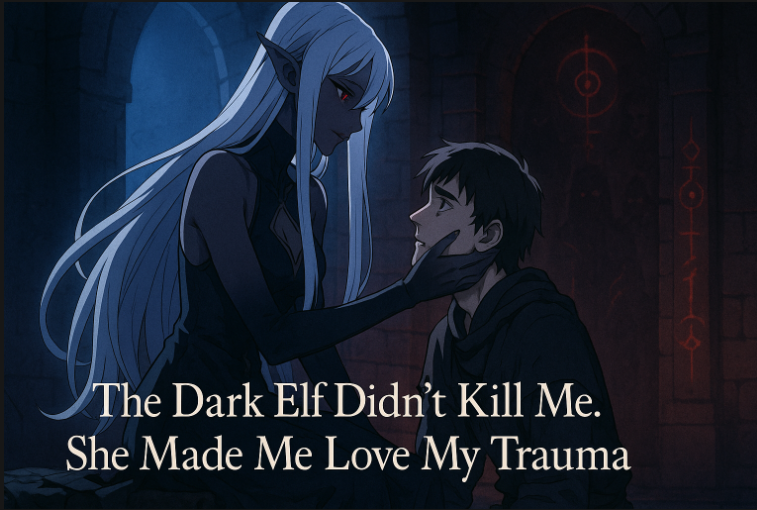
There’s always that moment in a dark fantasy anime.
The part where the beautiful, cold, otherworldly elf walks into the frame — pale skin, silver or violet eyes, maybe a tragic backstory hanging behind her like a shadow you can’t ignore.
And let’s be honest: we all think she’s going to kill us.
Or emotionally ruin us.
Or both.
But sometimes… she doesn’t.
Sometimes the dark elf doesn’t destroy you — she reflects you. And suddenly, you’re not watching for action or magic. You’re watching because you see yourself in her scars. Her silence. Her rage.
That’s what happened when I found Yandere — the dark elf from that quiet but brutal corner of anime you either stumble into or seek out when you’re already a little cracked inside.
This isn’t just a post about aesthetic appreciation.
This is about how the “yandere dark elf anime” girl helped me stop resenting my pain — and start learning from it.
The Broken Blade in Silk: Who Is “Yandere” and Why She Hits So Hard
Let’s talk archetype first.
The “yandere” in yandere dark elf anime comes from “yandere,” “tsundere,” etc. — but in this case, “yandere” feels like its own category. She’s not just a dark-skinned fantasy elf. She’s not tsundere, not kuudere, not yandere.
She’s… beyond caring.
Not because she’s heartless — but because she’s seen too much.
The typical yandere dark elf character lives at the crossroads of three things:
Immense power she didn’t ask for
Centuries of pain she pretends no longer matter
A guarded softness that only shows up when no one’s watching
Take characters like Frieren (Frieren: Beyond Journey’s End) or Ais Wallenstein from DanMachi. Neither are explicitly labeled “dark elves,” but they echo the vibe — emotionless, competent, mysterious, and deeply wounded. But go a little darker — into anime like Grancrest Senki or Record of Grancrest War, and you’ll find literal dark elves who’ve been hunted, hated, and hardened.
That’s where the “yandere” shows up.
She isn’t shy or flirtatious. She doesn’t exist to be a waifu.
She exists because her trauma doesn’t fit into anyone else’s story neatly.
And instead of being rescued — she rescues herself, or dies trying.
No monologue. No tears. Just a sword, a mission, and silence.
Why This Hits So Differently (Hint: It’s Not Just the Armor)
What makes the yandere dark elf anime girl powerful isn’t just the armor, the cool magic, or the lore.
It’s that she doesn’t need to “overcome” her trauma to be valid.
In so much media, pain is something to get past.
You “heal.” You “move on.” You “find peace.”
But the dark elf? She just keeps going. With pain. With rage. With everything intact.
And that’s what makes her emotionally powerful — she functions while fractured.
There’s a moment in one of these series (no spoilers, but if you know, you know) where the dark elf character is offered a second chance at a normal life. No battles, no blood, just quiet peace.
And she refuses.
Not out of pride. Not out of fear.
But because she knows the violence she’s endured changed her forever — and pretending otherwise would be a lie.
That shook me.
Because for the first time in a long time, I wasn’t being told to “get better.”
I was being told it’s okay to be different now.
Loving Your Trauma (Without Romanticizing It)
Here’s where this gets personal.
When I first started watching darker fantasy anime — especially those with elf or demi-human characters — I didn’t expect to feel seen. I just liked the atmosphere. The swords. The world-building.
But then I noticed something weird:
I kept gravitating toward the characters who didn’t want redemption.
Who didn’t cry for help.
Who weren’t broken in a dramatic way — just… deeply tired.
Characters like Yandere.
She’s not there to be fixed. She doesn’t want a savior.
She wants understanding — and maybe, someone who doesn’t flinch at her darkness.
And when I saw her refusing to let go of her trauma just to make others comfortable…
I realized I’d been doing the opposite.
I’d been apologizing for how trauma shaped me.
Apologizing for being more guarded. More distant. Less “fun.”
Apologizing for needing space when I hit sensory overload or for zoning out when people expected full attention.
But if Yandere can stand in the middle of chaos, blade out, heart locked up tight — and still be seen as powerful, valid, whole…
Then maybe I didn’t need to be a “before and after” story either.
Trauma Isn’t a Side Quest — It’s the Main Campaign
This is what makes the andere dark elf anime archetype timeless.
She doesn’t treat trauma as a backstory. She lives in it, works with it, and builds her entire worldview through it.
She’s not emotionally unavailable.
She’s selectively open.
She’s not heartless.
She just stopped offering pieces of herself to people who wouldn’t understand them.
And if that’s not relatable in 2025, I don’t know what is.
These characters reflect a truth a lot of us live with:
You don’t always get to heal.
You don’t always get closure.
Sometimes, you just carry your pain like a sword — and move forward anyway
Not despite the damage.
With it.
Final Thoughts: She Didn’t Kill Me. She Showed Me How to Survive.
So no — the dark elf didn’t kill me.
She saw the cracks. The quiet shame. The rage I couldn’t voice.
And she didn’t flinch.
She didn’t offer healing.
She offered a mirror.
And in that mirror, I saw someone who didn’t need to be fixed — just respected.
If you’ve ever felt like your story doesn’t fit neatly into a three-act structure…
If you’ve ever been told you’re “too much,” “too cold,” or “too angry”…
If you’ve ever stopped trying to explain yourself because it was easier to be misunderstood —
Then yeah.
You already understand what makes the yandere dark elf anime girl unforgettable.
She’s not just cool.
She’s a reminder that we don’t owe anyone a softer version of ourselves.

- Vegeta’s Pride Was Never Arrogance — It Was the Fear of Being Forgotten - October 30, 2025
- When Whitebeard Died Smiling — The Definition of a Complete Life - October 28, 2025
- Nami’s “Help Me” — The Most Human Moment in One Piece - October 25, 2025